![lodo ncr [recovered] png (1)](https://ncrfarms.in/wp-content/uploads/2025/12/cropped-lodo-NCR-Recovered-png-1-2-192x64.png)
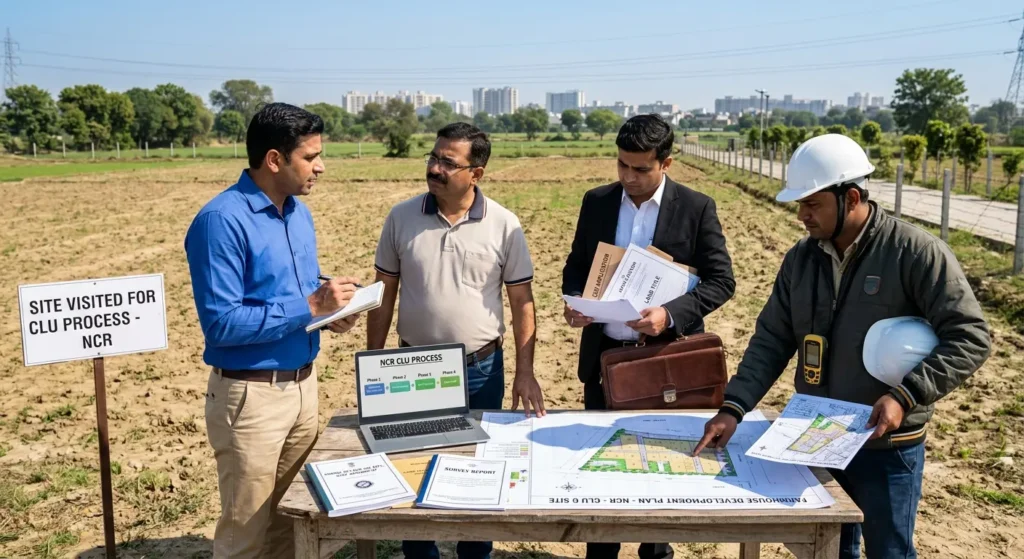
Introduction
The National Capital Region (NCR) has witnessed a remarkable rise in demand for farmhouses, agricultural land, and gated farmland communities. Improved infrastructure, including the Delhi-Mumbai Expressway, has encouraged investors and homebuyers to explore locations such as Naugaon, Sohna, Alwar, and nearby regions for lifestyle and investment purposes. However, one of the most important aspects of developing a farmhouse property is understanding the Change of Land Use (CLU) process.
Whether you are planning to build a weekend retreat, luxury farmhouse, or invest in land for future development, knowing how the CLU process works can save time, money, and legal complications.
This guide explains everything farmhouse owners in NCR need to know about navigating the CLU process.
What is CLU (Change of Land Use)?
Change of Land Use (CLU) is the legal approval granted by the competent government authority to convert land from one permitted use to another.
For example, agricultural land may require CLU approval before it can be legally used for:
- Residential development
- Commercial projects
- Institutional buildings
- Farmhouse construction (where applicable under local regulations)
- Mixed-use developments
The rules vary depending on the state, district, development authority, and local planning regulations.
Why is CLU Important for Farmhouse Owners?
Many buyers assume that purchasing agricultural land automatically allows farmhouse construction. However, this is not always true.
Obtaining CLU helps ensure that:
- Your construction complies with local regulations.
- The property receives legal approvals.
- Future resale becomes easier.
- Financing opportunities improve.
- Government penalties or legal disputes can be avoided.
Investing in legally compliant land protects your investment over the long term.
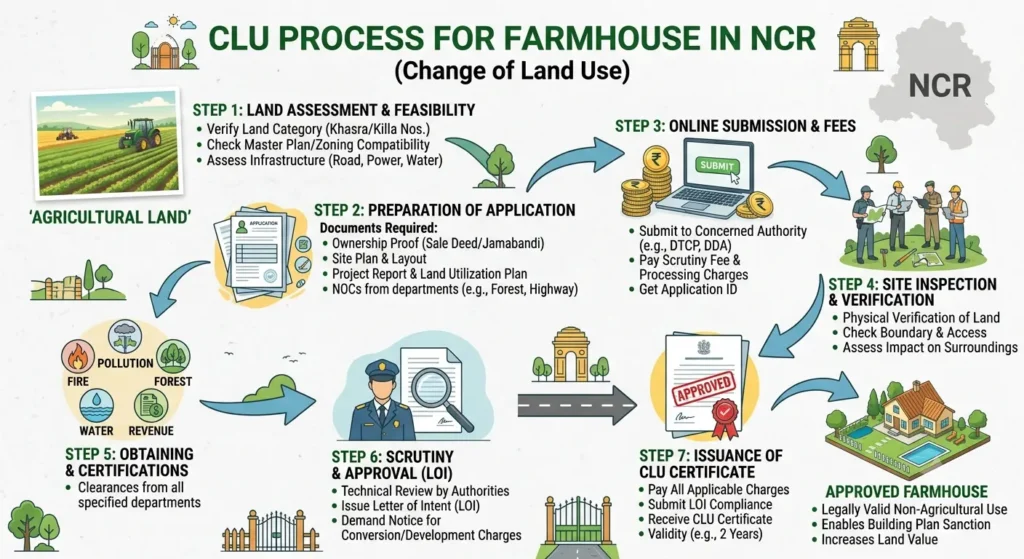
Step 1: Verify the Land Title
Before applying for CLU, verify that the land has a clear and marketable title.
Important checks include:
- Ownership records
- Sale deed
- Mutation records
- Revenue documents
- Encumbrance certificate
- Land survey details
A legal verification by a qualified property lawyer is highly recommended.
Step 2: Confirm Land Classification
Determine the existing classification of the property.
Common categories include:
- Agricultural land
- Residential land
- Commercial land
- Industrial land
- Institutional land
The classification determines whether CLU is required before construction.
Step 3: Review Local Development Plans
Every district has master plans prepared by planning authorities.
These plans identify:
- Residential zones
- Agricultural zones
- Industrial areas
- Green belts
- Future infrastructure corridors
- Restricted development zones
Reviewing the master plan helps determine whether your proposed use is permissible.
Step 4: Consult the Relevant Authority
CLU approvals are generally handled by the appropriate government authority depending on the location.
Authorities may include:
- Town and Country Planning Department
- Development Authorities
- Urban Local Bodies
- Revenue Departments
Speaking with the concerned office or a qualified consultant can help clarify the applicable rules.
Step 5: Prepare Required Documents
Although documentation requirements differ by state, applicants typically need:
- Identity proof
- Address proof
- Sale deed
- Land ownership records
- Site plan
- Revenue documents
- Survey map
- Affidavits (if applicable)
- Application forms
- Photographs
- No Objection Certificates (where required)
Submitting complete documentation reduces processing delays.
Step 6: Submit the CLU Application
Once the documents are ready, submit the application to the appropriate authority.
The application generally includes:
- Land details
- Ownership information
- Proposed land use
- Site plans
- Supporting documents
- Applicable government fees
Ensure all details are accurate to avoid rejection or requests for additional information.
Step 7: Site Inspection
Government officials may inspect the property to verify:
- Existing land use
- Access roads
- Boundaries
- Environmental considerations
- Compliance with planning regulations
The inspection helps authorities assess whether the proposed land use aligns with local development policies.
Step 8: Technical Evaluation
After inspection, officials review:
- Master plan compatibility
- Infrastructure availability
- Environmental impact
- Public utility access
- Road connectivity
- Safety considerations
Additional clarifications may be requested during this stage.
Step 9: Approval and Payment of Charges
If the proposal satisfies all regulatory requirements, the authority may grant CLU approval subject to applicable terms and conditions.
Applicants may need to pay:
- CLU charges
- Development charges
- Infrastructure fees
- Other statutory charges as prescribed
Always retain copies of receipts and approval documents for future reference.
Step 10: Begin Construction After Necessary Permissions
Receiving CLU approval does not automatically authorize construction.
Depending on local regulations, additional approvals such as building plan sanctions or other statutory permissions may be required before starting any development.
Always ensure all required approvals are in place before construction begins.
Common Mistakes to Avoid
Many buyers make avoidable errors during the CLU process, such as:
- Purchasing land without title verification
- Ignoring zoning regulations
- Assuming all agricultural land can be developed
- Starting construction before obtaining approvals
- Failing to verify government notifications
- Overlooking environmental restrictions
Careful planning can prevent costly legal issues later.
Benefits of Buying Legally Approved Farmhouse Projects
Many reputed developers offer projects with proper documentation and approvals.
Benefits include:
- Clear legal documentation
- Better resale value
- Improved buyer confidence
- Easier financing options
- Transparent ownership records
- Reduced legal risk
Choosing a professionally managed project can simplify the investment process.
Why NCR Farmhouse Investments Are Growing
The NCR region continues to attract farmhouse buyers due to:
- Improved expressway connectivity
- Rising demand for second homes
- Weekend lifestyle destinations
- Affordable land options in emerging locations
- Increasing infrastructure investments
- Long-term appreciation potential
Areas connected to major highways are becoming preferred destinations for both investors and end-users.
Tips for First-Time Farmhouse Buyers
If you’re purchasing farmhouse land for the first time:
- Verify ownership documents carefully.
- Check whether CLU or other approvals are required.
- Review the local master plan.
- Visit the site personally.
- Confirm road connectivity and utilities.
- Consult legal and property experts before investing.
- Avoid transactions based solely on verbal assurances.
These precautions can help you make a secure and informed investment.
Conclusion
Understanding the CLU process is an essential step for anyone planning to develop or invest in farmhouse land in the NCR region. While procedures and requirements vary across states and local authorities, proper due diligence, document verification, and compliance with planning regulations can help ensure a smooth investment journey.
As infrastructure projects continue to transform regions around Delhi NCR, interest in farmhouses and plotted developments is expected to grow. By following the correct legal process and obtaining the necessary approvals, investors can protect their assets, enhance future resale value, and enjoy the long-term benefits of owning a farmhouse in one of India’s fastest-growing real estate corridors.
10 FAQs: Navigating the CLU Process – A Step-by-Step Guide for Farmhouse Owners in NCR
1. What is CLU, and why is it important for farmhouse owners in NCR?
CLU (Change of Land Use) is the official approval required to convert land from one permitted use to another, depending on applicable state and local regulations. For farmhouse owners in the NCR, understanding the CLU process is essential to ensure legal compliance, avoid disputes, and facilitate future development or resale.
2. Is CLU mandatory for building a farmhouse on agricultural land?
It depends on the location and the regulations of the respective state or local planning authority. In some areas, farmhouse construction may be permitted under specific conditions, while in others, CLU or additional approvals may be required. Buyers should always verify the applicable rules before starting construction.
3. Which government authority grants CLU approval in NCR?
CLU applications are generally handled by the relevant Town and Country Planning Department, Development Authority, Urban Local Body, or Revenue Department, depending on the state and district where the property is located. The approving authority may differ between Haryana, Rajasthan, Uttar Pradesh, and Delhi NCR regions.
4. What documents are usually required for the CLU application?
Although requirements vary by state, applicants typically need the sale deed, ownership records, identity proof, address proof, site plan, land survey documents, revenue records, and any other supporting documents specified by the concerned authority. Providing complete documentation helps speed up the approval process.
5. How long does the CLU approval process usually take?
The processing time depends on the property’s location, document verification, site inspections, and the workload of the concerned authority. Timelines can vary significantly, so applicants should consult the relevant department or a qualified property consultant for updated information.
6. What should buyers verify before purchasing farmhouse land in NCR?
Buyers should check the property’s legal title, ownership history, zoning classification, access roads, government approvals, land-use restrictions, and whether any permissions such as CLU or building approvals are required. Consulting a legal expert before purchase is strongly recommended.
7. Can I start constructing my farmhouse immediately after purchasing the land?
Not necessarily. Purchasing the land does not automatically grant permission to build. Depending on local laws, you may need CLU approval, sanctioned building plans, or other statutory permissions before beginning construction. Always ensure all required approvals are obtained first.
8. What are the benefits of purchasing a legally approved farmhouse project?
A legally approved project generally offers better documentation, greater buyer confidence, smoother financing options, higher resale potential, and reduced legal risks. It also helps ensure that the project complies with local planning and development regulations.
9. Why are farmhouse investments becoming popular in the NCR region?
Farmhouse investments are gaining popularity due to improved infrastructure, better highway connectivity, growing demand for weekend homes, increasing interest in green living, and the appreciation potential of land in emerging locations. Areas connected to major expressways have attracted significant investor interest.
10. How can first-time investors simplify the CLU process?
First-time buyers should work with experienced legal advisors, verify all land records, understand local zoning regulations, consult the relevant planning authority, and purchase from reputed developers with transparent documentation. Proper due diligence can help avoid delays and ensure a secure investment.