![lodo ncr [recovered] png (1)](https://ncrfarms.in/wp-content/uploads/2025/12/cropped-lodo-NCR-Recovered-png-1-2-192x64.png)
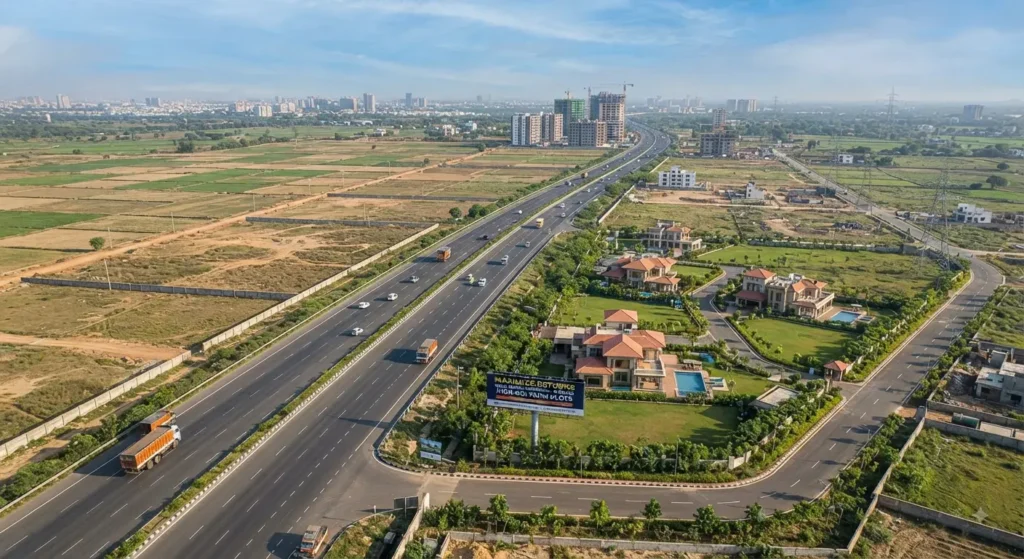
Land banking has emerged as an attractive real estate strategy for investors looking beyond conventional residential and commercial properties. In 2026, the Delhi-Mumbai Expressway corridor is gaining significant attention because of its improving connectivity, expanding infrastructure, and long-term development potential.
For smart investors, land banking is not simply about purchasing a piece of land and waiting. It is about identifying locations today that could benefit from tomorrow’s infrastructure, economic activity, population growth, and urban expansion. The Delhi-Mumbai Expressway corridor brings several of these factors together, making it an important destination for long-term real estate investment.
What Is Land Banking?
Land banking refers to purchasing land in a location with future development potential and holding it for an extended period. The objective is generally to benefit from appreciation as infrastructure, businesses, residential communities, and other developments gradually increase the area’s demand.
Unlike an investment in a ready-to-move property, land banking focuses primarily on future potential. Investors may purchase land when prices are relatively accessible and hold it while the surrounding region develops.
However, land banking requires patience and careful due diligence. Location, land title, zoning regulations, access roads, development plans, and legal approvals can all influence the future value of land.
Why the Delhi-Mumbai Expressway Matters in 2026
The Delhi-Mumbai Expressway is one of India’s major infrastructure corridors, designed to improve connectivity between the National Capital Region and western India. Its influence extends beyond faster road travel. Large expressway projects can encourage economic activity, logistics development, industrial growth, warehousing, tourism, and new real estate opportunities along connected regions.
As connectivity improves, previously less-developed areas can become more accessible to major urban centres. This can gradually increase interest in residential plots, farmland, commercial land, logistics facilities, and other forms of real estate.
For land investors, this creates an important investment principle: infrastructure can change the economic importance of a location.
The Corridor Effect on Land Values
One of the biggest reasons investors study infrastructure corridors is the potential “corridor effect.”
When a major highway or expressway becomes operational, surrounding areas can experience increased accessibility. Better connectivity may attract businesses, employees, developers, hospitality projects, and supporting infrastructure.
Over time, this can create multiple layers of demand.
For example, a location connected to an expressway may benefit from:
- Improved road accessibility
- Greater commercial activity
- Logistics and warehousing demand
- Growth of nearby residential communities
- Increased tourism potential
- Better connectivity to major cities
- Expansion of supporting infrastructure
These factors can make strategically located land more attractive over the long term.
Why Land Banking Is Becoming Popular Among Investors
Traditional real estate investment often involves purchasing apartments, commercial units, or completed properties. These assets can generate rental income, but they may also involve maintenance expenses, vacancy risks, and substantial acquisition costs.
Land banking follows a different approach.
The investor focuses on location and future appreciation potential rather than immediate rental income. Because undeveloped land can have fewer maintenance requirements than constructed property, some investors find the strategy appealing for long-term wealth creation.
The key is selecting the right location before significant development takes place.
The Delhi-NCR Connection
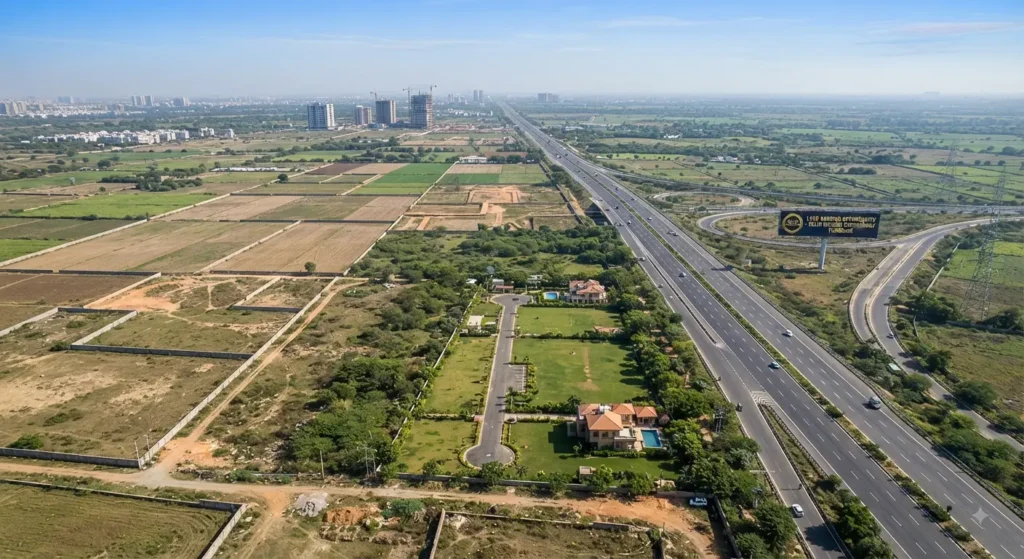
Delhi-NCR remains one of India’s most important economic regions. Gurgaon, Delhi, Faridabad, and other surrounding areas have experienced substantial residential and commercial expansion.
The Delhi-Mumbai Expressway adds another layer of connectivity to this broader ecosystem. Areas around the expressway can become increasingly relevant as people and businesses look for locations offering better access to Delhi-NCR while potentially providing comparatively attractive land prices.
This makes the corridor particularly interesting for investors who are willing to take a long-term view.
Naugaon and the Emerging Land Investment Opportunity
Naugaon in Rajasthan has increasingly attracted attention from land and farmhouse investors because of its connectivity to the Delhi-NCR region and its position within the broader Delhi-Mumbai Expressway influence zone.
The region appeals to investors looking for larger land parcels, managed farmland communities, farmhouse opportunities, and long-term real estate prospects.
Its appeal is supported by several factors, including improving connectivity, proximity to Delhi-NCR, relatively open landscapes, and growing interest in weekend and second-home destinations.
However, investors should not assume that every parcel in Naugaon will automatically appreciate. The exact location, road access, ownership records, land-use permissions, and development conditions remain critical.
What Makes a Good Land-Banking Location?
Not every piece of land near an expressway is a good investment. Smart land banking requires a detailed evaluation of the property and its surrounding area.
1. Connectivity
Proximity to major highways is important, but direct accessibility matters just as much. Investors should examine the actual approach road, travel time, nearby junctions, and planned infrastructure.
2. Legal Documentation
Clear ownership is essential. Investors should verify title documents, revenue records, mutation details, encumbrances, and other relevant documentation before purchasing land.
3. Land-Use Regulations
Agricultural, residential, commercial, and other land categories have different regulations. Buyers should understand the permitted use of the property and avoid assuming that agricultural land can automatically be converted into a residential or commercial development.
4. Surrounding Development
Study what is happening around the property. Existing roads, nearby villages, commercial activity, hospitality projects, industrial developments, and proposed infrastructure can provide useful clues about future demand.
5. Holding Period
Land banking is generally a long-term strategy. Investors should be prepared to hold the property for several years rather than expecting immediate returns.
The Role of Infrastructure in Future Growth
Infrastructure is often one of the strongest catalysts for regional real estate development.
A major expressway can improve access to previously distant destinations. Better connectivity can reduce travel friction and make locations more practical for businesses, residents, tourists, and investors.
But infrastructure should be viewed as a growth catalyst, not a guaranteed return.
Land prices depend on numerous factors, including supply and demand, economic conditions, government policies, development permissions, local infrastructure, and market sentiment.
Therefore, investors should combine infrastructure research with property-level due diligence.
Land Banking vs. Traditional Property Investment
Land banking can be compared with traditional property investment in several ways.
A completed residential property may provide rental income and immediate usability. Land, on the other hand, may offer greater flexibility but typically does not generate regular rental income unless it is used productively.
Land banking can therefore suit investors who:
- Have a long investment horizon
- Do not require immediate rental income
- Prefer land-based assets
- Are comfortable with market fluctuations
- Understand local property regulations
- Conduct thorough due diligence
The strategy may not be suitable for someone seeking quick returns or immediate cash flow.
Why 2026 Could Be an Important Year for Investors
The year 2026 represents an interesting phase for infrastructure-led real estate investing. As major connectivity projects become increasingly integrated with regional development, investors are paying greater attention to locations that sit along emerging growth corridors.
The Delhi-Mumbai Expressway is part of a broader infrastructure story involving highways, logistics networks, industrial zones, urban expansion, and tourism.
For investors, the opportunity lies in identifying locations before they become fully mature markets.
This is the fundamental idea behind land banking: buying based on future potential rather than only today’s development level.
Due Diligence Should Come Before Returns
One of the biggest mistakes in land investment is focusing entirely on expected appreciation.
A promising location does not compensate for poor documentation.
Before purchasing land, investors should independently verify:
- Ownership and title
- Encumbrances
- Revenue records
- Land classification
- Mutation status
- Access and road connectivity
- Applicable development regulations
- Local authority permissions
- Existing litigation, if any
- Physical boundaries and measurements
- Seller credentials
- Registration and transaction costs
Professional legal and property advice can be valuable, particularly when dealing with large land parcels.
A Long-Term Approach to Smart Investing
The strongest land-banking strategies are generally based on patience rather than speculation.
Investors should identify a location with genuine development potential, purchase a legally secure property at a reasonable valuation, and maintain realistic expectations about the holding period.
The Delhi-Mumbai Expressway corridor offers an interesting combination of infrastructure and regional connectivity. As surrounding areas continue to evolve, strategically located land may become increasingly valuable.
However, investors should remember that location quality matters more than simply being “near the expressway.”
Conclusion
Land banking in 2026 is increasingly being viewed as a strategic approach to long-term real estate investing. The Delhi-Mumbai Expressway corridor stands out because improved connectivity can encourage economic activity, infrastructure development, logistics, tourism, and urban expansion.
For investors exploring opportunities around Delhi-NCR and Rajasthan, locations such as Naugaon can be worth researching as part of a broader land-investment strategy.
The real opportunity is not simply buying land beside a major highway. It is identifying legally secure, strategically positioned land in a region with sustainable development potential.
With proper research, realistic expectations, professional due diligence, and a long-term investment horizon, land banking can become an important component of a diversified real estate portfolio.
In 2026, the Delhi-Mumbai Expressway corridor may well represent one of the country’s most interesting infrastructure-led investment stories—but smart investors will focus on fundamentals, not just the excitement surrounding the corridor.
FAQs: Land Banking in 2026 and the Delhi-Mumbai Expressway Corridor
1. What is land banking in real estate?
Land banking is the practice of purchasing land in an area with future development potential and holding it for the long term. Investors generally expect the property’s value to increase as infrastructure, connectivity, population, and economic activity develop around the location.
2. Why is the Delhi-Mumbai Expressway corridor attracting land investors in 2026?
The Delhi-Mumbai Expressway corridor is attracting attention because improved connectivity can support economic development, logistics, tourism, commercial activity, and residential expansion. These factors can increase interest in strategically located land over time.
3. Is land banking a good investment strategy in 2026?
Land banking can be suitable for investors with a long-term investment horizon and the ability to hold property without expecting immediate income. However, returns are not guaranteed, so investors should carefully evaluate location, legal documentation, development potential, and market conditions.
4. How can the Delhi-Mumbai Expressway influence nearby land prices?
Improved connectivity can make surrounding locations more accessible and attractive to businesses, residents, developers, and investors. Increased demand may support land-value appreciation in selected areas. However, being close to an expressway alone does not guarantee price appreciation.
5. Is Naugaon a potential location for land banking?
Naugaon has attracted interest from investors because of its connectivity to Delhi-NCR, its location within the broader Delhi-Mumbai Expressway influence zone, and growing interest in farmland and farmhouse destinations. Investors should evaluate each property individually rather than assuming that every parcel will appreciate.
6. What should investors check before buying land near the expressway?
Investors should verify ownership, title documents, revenue records, mutation status, encumbrances, land classification, access roads, applicable land-use regulations, physical boundaries, and any relevant approvals or litigation. Independent legal verification is advisable before making a purchase.
7. Does land banking provide regular rental income?
Generally, undeveloped land does not provide regular rental income like a leased commercial property or residential unit. Land banking primarily focuses on potential long-term appreciation, so it may be more appropriate for investors who do not require immediate cash flow.
8. How long should investors hold land for land banking?
There is no fixed holding period because development timelines vary by location. Land banking is generally considered a long-term strategy, and investors should be prepared to hold the property for several years while the surrounding region develops.
9. What makes a good land-banking location?
A strong land-banking location typically combines good connectivity, clear property documentation, suitable land-use regulations, reasonable pricing, surrounding development, and credible long-term growth prospects. Future infrastructure and accessibility can also influence investment potential.
10. Is every property near the Delhi-Mumbai Expressway a good investment?
No. Proximity to the expressway should not be the only investment criterion. Investors should also examine approach roads, title clarity, zoning, surrounding development, market demand, local infrastructure, and the property’s overall legal status.
11. What are the major risks associated with land banking?
Important risks include unclear titles, land disputes, changing regulations, limited access, slower-than-expected development, market fluctuations, and difficulty selling the property when required. Investors should conduct thorough due diligence before committing capital.
12. How does infrastructure affect land investment?
Infrastructure can improve accessibility and encourage economic activity. New roads, expressways, logistics facilities, commercial centres, and supporting infrastructure can increase the attractiveness of nearby locations. However, infrastructure should be considered a potential growth catalyst rather than a guarantee of returns.