![lodo ncr [recovered] png (1)](https://ncrfarms.in/wp-content/uploads/2025/12/cropped-lodo-NCR-Recovered-png-1-2-192x64.png)
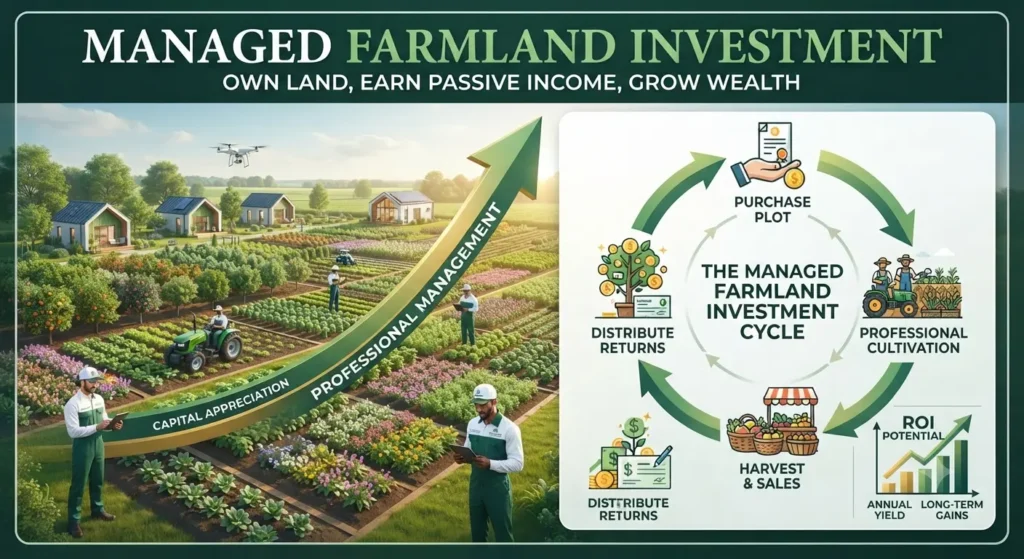
Traditionally, investments in real estate have been linked to residential apartments, commercial buildings and traditional plots of land. A new investment area, though, is gaining traction in the minds of investors—managed farmlands. Managed farmland communities are emerging as an alternative to land market participation, being linked with land ownership and the professional management, and use of these lands for agricultural or nature-based activities.
This can be an interesting land ownership model for investors who wish to have land but are not interested in doing their own maintenance. It can provide a means of generating revenue from land and the longer term value of owning land.
But don’t think that managed farmland is a sure passive income. The returns vary depending on the location, land-use regulations, management level, demand, operating expenses and the income model of the project. It is important to be aware of these factors before investing.
What is a Managed Farmland?
Managed farmland is typically an area of agricultural or permitted land that is professionally managed by an individual, company or organized group. Management services can vary from project to project and could involve landscaping, plantation, irrigation, security, farm maintenance and other operations.
Some communities may also provide shared amenities or develop farming-related experiences. The exact structure varies depending on the project at hand.
Convenience is the key, the great thing. An investor may be better served by an organized system where day-to-day maintenance is done professionally, as opposed to buying agricultural land and working it on their own.
Managed Farmlands are gaining popularity as a result of what?
One of the major factors that led to the increase in managed farmlands is the change in the preference of the investors.
A lot of people would like to acquire a different kind of property besides apartment buildings and standard houses. Ownership and value can be fulfilled in the form of land and farmland, and there is a natural and agricultural link that can be achieved in both forms.
As urbanisation advances, there has been a rise in demand for properties away from the dense areas of urban centres. Prospects are drawn to areas near major cities for weekend retreats, second homes, farm living, and investment potential.
The emerging areas of Naugaon and other developing corridors have been in focus for investors in and around Delhi-NCR due to the infrastructure development and connectivity.
What is the way that land can earn a passive income?
Passive income does not just occur when you own land. Legal and commercial use of the land is the source of income.
There are a number of different possibilities for a managed farmland project to provide a source of income:
Agricultural Income
Some farmland projects may permit the growing of fruit, vegetable, herbs, timber or other crops as a legitimate activity. The landowner might generate income from agricultural production based on the arrangement.
The actual returns depend on the weather, market prices, input prices, water availability and market conditions in farming operations.
Farm Produce
A professionally managed farm can produce products for local or regional markets. A landowner might consider a revenue-sharing agreement if the management company is responsible for growing the crop, harvesting it, packaging it and selling it.
The agreement should be thoroughly reviewed by investors to understand how the investors will receive the revenue.
Farm Experiences
Managed communities may also have tourism or leisure activities, as long as these are legally allowed. These can be farm stays, nature encounters, workshops or recreation.
With the appropriate approvals and professional operations, such models have the potential to generate more revenue.
Plantations and Long-term Crops
Some projects could be based on plantations. The growth period for trees and perennial crops may be extended and can be located as long-term assets.
Investors need to be wary of guaranteed returns or returns that are significantly above the average, while at the same time being aware of the biotic, operational and legal challenges of the plantation model.
The full significance of location.
One of the most crucial considerations for any land investment is its geographical location.
A farm that is near an expressway, airport, cities and employment centers can have greater long term demand than a farm of similar prices in a remote area.Connectivity may also have an impact on the property’s functionality as a weekend getaway or second home.Investors in Delhi-NCR should consider areas near key infrastructure initiatives. Obviously, investors should consider actual levels of road access, travel times, surrounding development, planned infrastructure, and government approvals – not just the claims in the advertising.
By using professional management, it is possible to make a difference.
Management is the hallmark of managed farmland.
Irrigation, planting, landscaping, security, maintenance, harvest, and general care are all activities which can be managed by a good management team. This can help ease the burden on absentee landlords.
This could be beneficial for residents of Delhi, Gurugram, Noida or any other city. Owners may not be able to keep track of rural land ownership or have the time and knowledge to visit and care for it on a regular basis.
Before investing, investors should research the manager’s experience, track record, operating model, contractual obligations and financial terms.
Passive Income is not synonymous with passive ownership.Passive income is not necessarily passive ownership.
Passive ownership vs passive income is important to understand.
When the maintenance of managed farmland is delegated to professionals, it can be a relatively passive process to owning the land. But that does not imply that the property will yield regular income.
Investors should ask:
- So, where is the income coming from?
- Who runs the farm?
- How to measure revenue?
- Do you have to pay any management fees?
- What costs are subtracted?
- Does the income come in a steady stream or is it unpredictable?
- What happens if farmers are not successful in their agricultural activities?
- Does it have a lock in period?
- Is there a free market in the land?
It is more important to find the answers to these questions than to find enticing projected returns.
Capital Appreciation Potential
Investors should also take into account land appreciation, apart from the possibility of earning income.
Land values may increase when an area expands because of improved infrastructure, increased economic development, or expanding demand for residential development.
Farmland in an important growth corridor can thus offer two advantages as an investment: its ability to generate income and its future value.
But thank you is never promised. Development restrictions, economic conditions, local demand, infrastructure timelines and regulations are all factors that can impact rural and agricultural land markets.
Due Diligence Is Essential
Careful documentation check is essential when investing in land.
A potential buyer of a managed farmland should confirm the land-use classification, the title, land ownership history, land encumbrances, access rights, local registration and land-use regulations.
In the case of a project with promised amenities, plantations, farmhouses, roads or commercial activities, buyers should consult the project’s legal status and the extent to which it is legally approved.
An experienced property lawyer can examine papers and contracts prior to acquisition.
Understanding the Management Agreement
One thing to note about the management agreement is that it is a document that needs special attention.
It should be clear who is responsible for maintaining the property, how expenses will be dealt with, how profits or income will be shared and what will happen if there is a change of management company or the agreement comes to an end.
Another important factor that investors need to be aware of is whether the management fee is a fixed amount, a percent of assets under management, or based on the services provided.
A clear agreement helps to establish clear responsibilities early in the process between the landowner and the operator.
Managed Farmland, who should consider it?
There are various categories of buyers who may want to purchase managed farmland.
It could be a good option for long-term investors looking to diversify their real estate portfolio. In the city, professionals might appreciate professionally maintained land, but not have to run the show themselves. Farmland can also be important for families for being a place to travel for a weekend or for a nature experience (where legal).
It’s not ideal for investors who are looking for a steady income stream or quick profits, however.
The duration of the investment should be about the same length as the nature of the asset and the income stream from the asset.
The Future of Managed Farmland
The new trend of managed farmlands shows a general trend of the preference of real estate. There is a growing interest by investors in owning assets that bring together lifestyle, nature and future financial gains.
Professionally managed land communities are likely to remain an attractive option for urban dwellers looking for alternatives to regular apartments and plots, given the ongoing urbanisation and the ease of connectivity.
But the effectiveness of this model will rely on transparency, legality, expert management and real economic activity – not promises of marketing.
Conclusion
Managed farmland investment is an interesting phenomenon that has occurred in the real estate market. Managed farmland can be a novel way for investors to invest in property as it merges land ownership with professional maintenance and may be an avenue for income generation.
Investors know that income is not guaranteed, nor is it automatic, but it is an attractive possibility to get passive income from land. Important factors are location, documentation, management quality, operating costs, agricultural performance and legal permissions.
If investors are willing to adopt a long-term perspective and undertake proper due diligence, farmland managed by others can be an asset to diversified real estate investors. The most rational approach is to consider what’s on the land, the business concept and the business fundamentals as opposed to the promised returns before making an investment decision.



![lodo ncr [recovered] png (1)](https://ncrfarms.in/wp-content/uploads/2025/12/cropped-lodo-NCR-Recovered-png-1-2.png "lodo ncr [recovered] png (1)")